A bronze victory column, toppled once
The Colonne Vendôme in Paris is a 144-foot bronze column raised by Napoleon I between 1806 and 1810 to mark the victory at Austerlitz, its spiraling frieze cast from captured enemy cannon. Pulled down by the Paris Commune in May 1871, it was rebuilt by 1875 and has stood at the centre of the Place Vendôme since, listed as a protected monument in 1992.
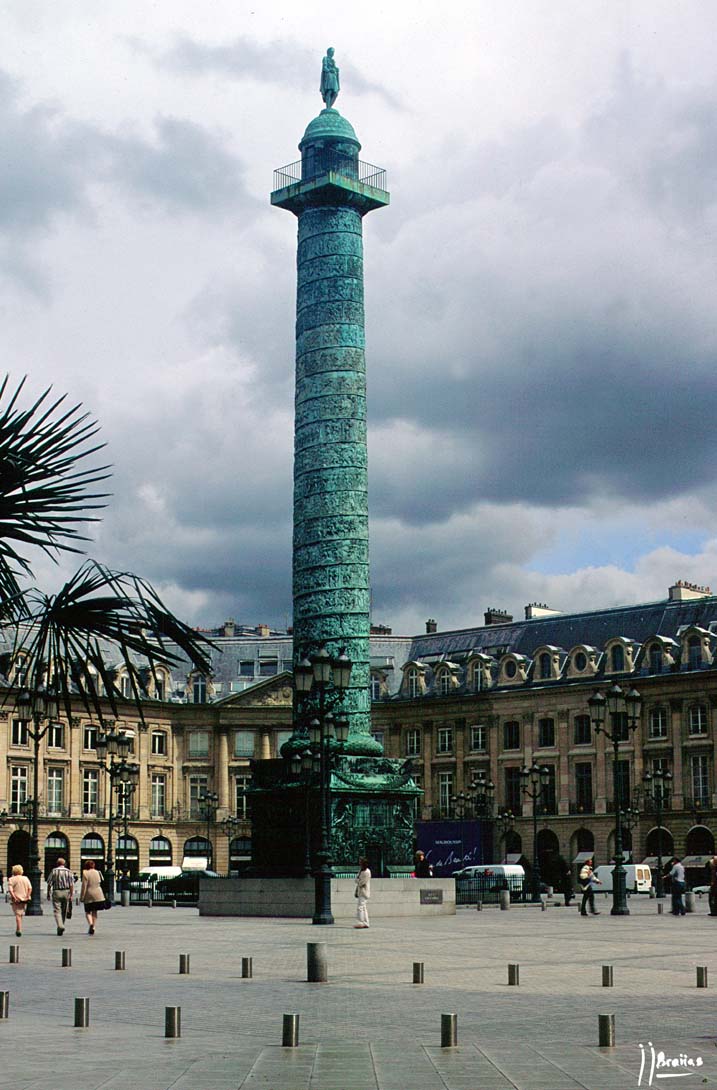
Napoleon raised a column from captured enemy cannon
The Colonne Vendôme is a bronze column still standing at the center of the Place Vendôme. It rises 144 feet above the square, modeled on Rome's Trajan's Column. Napoleon I ordered it built to mark his win over Austria and Russia at the Battle of Austerlitz in December 1805. Napoleon put Vivant Denon in charge of the whole project. The design called for a spiraling bronze frieze, 425 plates wrapped 22 times around the stone shaft, showing scenes from the 1805 campaign. Propaganda claimed the bronze came from 1,200 captured enemy cannons. Historians count closer to 180 guns actually taken at Austerlitz. About 30 sculptors carved the plates, including François Rude and Lorenzo Bartolini, working from drawings by Pierre-Nolasque Bergeret. A statue of Napoleon dressed as a Roman emperor, made by Antoine-Denis Chaudet, went up on top. The column was finished and dedicated on August 15, 1810, Napoleon's birthday.
A mob tore Napoleon's statue down by its neck
When the Bourbon kings returned to power, a mob tried to pull Chaudet's statue down by its neck in 1816. The column held, but the statue did not survive the decade. Royalist officials later took it down and melted it for bronze, used in a new statue of Henry IV on the Pont Neuf. Louis-Philippe put a replacement on top in 1833, showing Napoleon as a plain soldier in a greatcoat and boots, not a Roman emperor. Napoleon III later swapped that for a closer copy of Chaudet's original, finished by Auguste Dumont in 1863. That is the statue on the column today.
Courbet asked for the column to be moved, not destroyed
The painter Gustave Courbet looked at the column and saw a monument to war sitting on the Rue de la Paix, a street named for peace. On September 14, 1870, he asked the government to take the column apart and move it to a museum. He did not ask for it to be destroyed.
The Commune pulled the column down before a crowd
Paris was under the control of the Commune, a radical government that had seized the city. On April 12, 1871, the Commune decreed the column a "monument of barbarity" and a symbol of "brutal force and false glory." Crowds gathered on May 16 to watch it come down. Workers had cut grooves into the stone shaft. Cables, pulleys and winches pulled the column over, and it crashed into the square in pieces. Courbet had only proposed moving it. He was blamed for its destruction anyway, and he spent years afterward writing letters insisting he had wanted to preserve the column, not wreck it.
Courbet was billed for the column and died before paying
President Patrice de Mac-Mahon ordered the column rebuilt. The government billed Courbet for the full cost, more than 323,000 francs, and ordered him to pay roughly 10,000 francs a year for 33 years. Workers finished rebuilding the column on December 28, 1875, salvaging the original bronze plates where they could. The statue's victory globe was never found. Courbet fled to Switzerland rather than face another prison term and died there on December 31, 1877, the day before his first payment came due. He never paid a franc of it.
The column stands protected among jewelers and fashion houses
France listed the Colonne Vendôme as a protected historical monument on March 31, 1992. It still stands at the center of the Place Vendôme, ringed by the jewelers and fashion houses that have lined the square for a century. The Hôtel Ritz Paris sits a short walk from its base.
The bronze column rises above the square exactly where it fell in 1871, rebuilt and standing again.
Every person, building and event in this story opens into its own dig in the app — and Strata will dig the ground under your feet instead, wherever that is, in about a minute, with every source shown.