A French teenage queen was buried a few streets from where you are standing, murdered on her husband's order.
Last reviewed 25 September 2026 · A three-minute read · 1231–1980
The short answer
Jerez de la Frontera Cathedral stands a short walk from the Iglesia-convento San Francisco, where Blanche of Bourbon, child bride of Peter I of Castile, was buried in 1361 after he ordered her killed. The cathedral district also lies near sites tied to the 1391 attacks on Jerez's Jewish community and the 1884 Mano Negra executions.
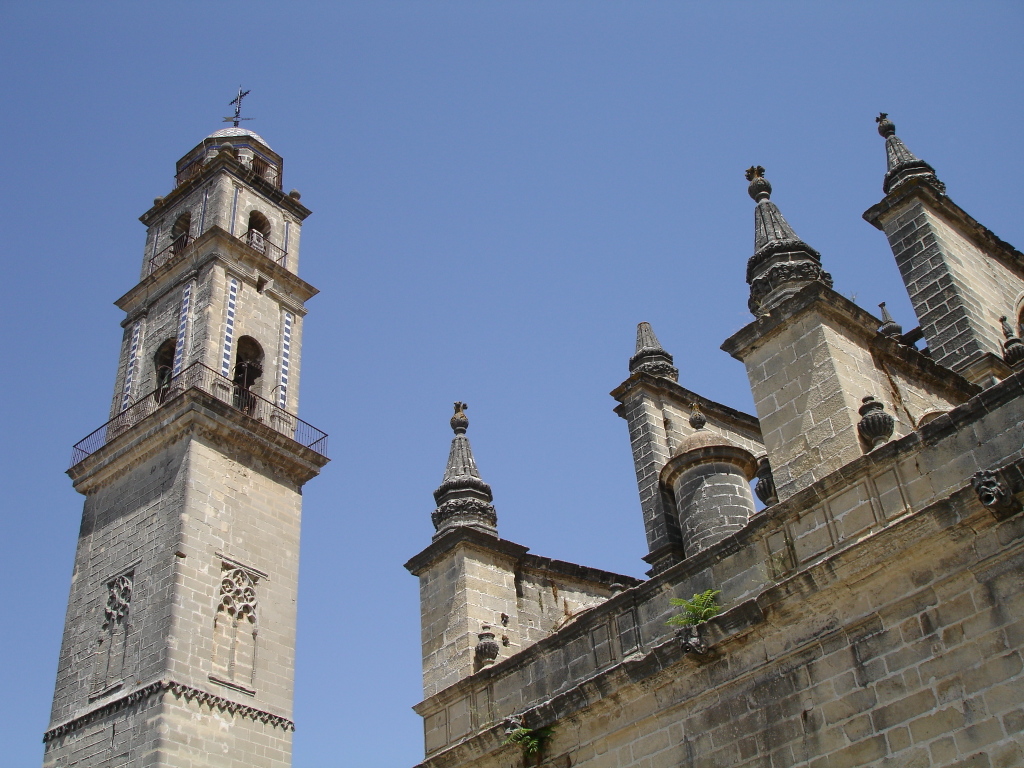
Tower of the cathedral of Jerez de la Frontera, Spain — 2006 · El Pantera · CC BY-SA 4.0
1339 to 1360
A French teenager was married off to seal a treaty
Blanche of Bourbon was born in France in 1339. She was a niece of the French king. At fourteen she was married to Peter I to seal an alliance between two crowns. The wedding took place in 1353. Peter left her within days. He already had a mistress, María de Padilla. He had no use for a foreign bride once the treaty was signed.
Blanche never ruled beside him. Peter moved her from fortress to fortress. She was a prisoner in her own marriage. She spent years shut away, watched, and cut off from the French court. That court had sent her to Castile expecting a crown.
Her husband's temper was already infamous by then. It would decide how her story ended.
1361
A king ordered his wife's death and her burial nearby
Peter had her killed in 1361. She was twenty-two. Contemporary accounts differ on the exact method. They agree on one thing: the order came from her own husband. He was the king she had been married to for less than a decade. She had barely lived with him at all.
Her body was brought to Jerez de la Frontera. It was buried in the Iglesia-convento San Francisco. This was a short walk from where you stand now. The convent church still holds her. She was a French queen who never held power in the kingdom that killed her.
A fourteen-year-old bride became a queen nobody wanted and a dead woman nobody protected.
3 November 1882 to June 1884
Seven men were strangled by garrote in a public square
Peter I was not the last man in Jerez to decide an inconvenient life could be ended by order. Five centuries later, the Jerez de la Frontera Cathedral stood only a short distance from a market square where the state did the same thing in public. Riots tied to drought and unemployment broke out in Jerez in November 1882. The Civil Guard and the army moved in and arrested around sixty people.
Investigators built a case against a supposed secret society they called the Mano Negra, the Black Hand. Seven men were sentenced to death. In June 1884 they were tied to a post one at a time in the Plaza del Mercado. They were strangled with an iron collar. This method was called the garrote. It was Castile's old habit of removing the inconvenient, done now with a warrant instead of a crown.
A dictator would later be brought back to this same city once his own usefulness ran out.
1930
A fallen dictator was buried quietly across the city
Miguel Primo de Rivera ruled Spain as a military dictator for seven years. He seized power in 1923 and lost the confidence of the king and army by 1930. He resigned and fled to Paris. He died there within weeks, discarded by the same crown he had once propped up.
His body did not stay in France. It was brought home to Jerez and buried in the Iglesia-convento de la Merced, a convent church in the city he came from. A general who had commanded a country ended up entombed quietly. He was buried a short distance from where a French queen had been buried five centuries earlier. She had been buried for the same reason: no longer wanted.
1391
A Jewish community sold its own cemetery under attack
Long before either of them, another group in Jerez learned what it cost to become inconvenient. Ninety Jewish families lived in the city's Judería district. In 1391, waves of anti-Jewish violence swept across Castile and reached Jerez. Attacks on the community forced survivors to sell part of their own cemetery to a Dominican monastery. Forty-nine people abandoned their faith under the pressure that followed.
A community that could not defend its living could not even hold onto the ground it buried its dead in.
The powerful of Jerez did not only kill the inconvenient. They kept them on display.
1491 and 1492
Converts were judged publicly and marked for centuries
The Inquisition held autos-da-fé in Jerez in 1491 and 1492. These were public ceremonies. They condemned Conversos — Jews who had converted to Christianity under pressure. They were accused of practicing their old faith in secret. Some were sentenced to wear the sanbenito, a penitential garment marking them as heretics.
Their sanbenitos were not put away after the ceremony. They hung inside the Church of San Dionisio for more than two centuries. They reminded every congregation that walked beneath them of who had been judged and discarded.
The cathedral tower still marks the ground where all of them, one way or another, stopped being useful to somebody more powerful than they were.
Read the ground you are standing on
Every person, building and event in this story opens into its own dig in the app — and Strata will dig the ground under your feet instead, wherever that is, in about a minute, with every source shown.
Sourced records, high and medium confidence. Era background is marked as such.
Medieval
1231
Castilian forces fought the Moors here in 1231 during the Reconquista, one of the events that shaped the frontier city's name — Jerez de la Frontera means "Jerez of the Frontier."
Ninety families made up the Jewish community of Jerez before the 1391 attacks; survivors later sold part of their cemetery to a Dominican monastery, and forty-nine Jews abandoned their faith under the pressure.
The Inquisition staged public penance ceremonies, autos-da-fé, in Jerez in 1491 and 1492, and the penitential garments of convicted Conversos still hung in the church of San Dionisio into the 18th century.
After a plague outbreak in 1494, Christians in Jerez were ordered to refuse shelter to anyone who had once been Jewish, sealing off the survivors from the rest of the city.
The Museo Arqueológico Municipal de Jerez was founded in 1873, merging archaeological collections donated by wealthy local families, and it occupies a building later declared a protected cultural property.
Drought, bad harvests and unemployment brought rioters into the streets of Jerez, and on 3 November 1882 the Civil Guard and army arrested around sixty people.
Following the Mano Negra affair — a case built on labor unrest in the early 1880s — seven men were executed by garrote in June 1884 in Jerez's Plaza del Mercado, near the archaeological museum.
Pedro Domecq Loustau, the winemaker who helped build the Domecq sherry house, died in 1894 and is buried here in Jerez de la Frontera Cathedral, along with several other Domecq family members.
Miguel Primo de Rivera, who ruled Spain as dictator from 1923 to 1930, died in 1930 and is buried at the Iglesia-convento de la Merced, over half a kilometer from here.
What happened at Jerez de la Frontera Cathedral's surrounding district in 1361?
Blanche of Bourbon, queen of Castile, was buried at the Iglesia-convento San Francisco, about 500 metres from the cathedral, after her husband Peter I had her killed at the age of twenty-two.
Who was Blanche of Bourbon?
She was a French noblewoman, a niece of the French king, married at fourteen to Peter I of Castile in 1353 to seal an alliance. He abandoned her within days for his mistress, María de Padilla, and had her killed in 1361.
What happened at the Plaza del Mercado near Jerez de la Frontera Cathedral?
Following riots and mass arrests in November 1882 tied to drought and unemployment, seven men convicted in the Mano Negra affair were executed by garrote there, one at a time, in June 1884.
What was here before the persecutions of 1391 affected the Jewish community of Jerez?
Ninety Jewish families made up the Jerez community before 1391. After attacks that year, survivors sold part of their cemetery to a Dominican monastery and forty-nine Jews abandoned their faith.
Who else is buried near Jerez de la Frontera Cathedral?
Miguel Primo de Rivera, the military dictator who ruled Spain from 1923 to 1930, died in Paris shortly after his fall and was buried at the Iglesia-convento de la Merced, a short distance from the cathedral.